







INDUSTRY INFORMATION
Industry News



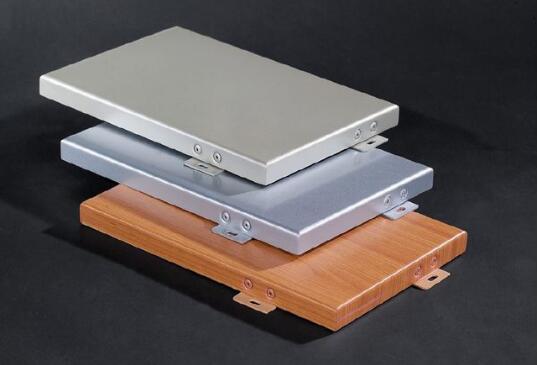
Aluminum curtain wall panels are the common term used by construction companies to refer to aluminum single panels for curtain walls; they’re also sometimes called curtain wall aluminum panels. In essence, aluminum curtain wall panels are custom-made aluminum single panels—high-end architectural decorative materials crafted from aluminum alloy sheets of a specific thickness, shaped and formed according to predetermined dimensions, configurations, and structural designs, and then coated with a protective finish on their surface. The panel’s structure primarily consists of components such as the face panel, reinforcing ribs, and hanging tabs.
The surface of fluorocarbon aluminum panels is coated with spray paints from renowned chemical companies such as PPG and Nippon Paint from the U.S., combined with Henkel’s film-coating technology from Germany, offering a wide range of colors and exceptional quality. Aluminum curtain wall panels are lightweight yet highly strong and rigid, waterproof, stain-resistant, fire-retardant, corrosion-resistant, and easy and convenient to install. They require low maintenance costs, have a long service life, are easily recyclable, and exhibit excellent workability. These panels can be fabricated into various complex shapes, including flat surfaces, curved surfaces, spherical surfaces, and tower-like forms. Under normal outdoor conditions, they remain colorfast for a period of 15 to 30 years, delivering outstanding decorative effects and making them the material of choice for curtain walls.
I. Classification of Aluminum Curtain Wall Panels
The first type of curtain wall aluminum panel is made from an aluminum-magnesium alloy containing a certain amount of manganese. The greatest advantage of this material is its excellent resistance to oxidation. Moreover, thanks to the presence of manganese, it boasts good strength and rigidity, making it the ideal material for curtain wall aluminum panels. The second type is made from an aluminum alloy with lower manganese and magnesium content. As a result, its strength and rigidity are significantly lower than those of the aluminum-magnesium and aluminum-manganese alloys. Due to its relatively soft nature, it’s easy to process, and as long as it reaches a certain thickness, it can basically meet the most fundamental flatness requirements for ceiling panels.
II. Common Applications of Aluminum Curtain Wall Panels
The processing techniques for curtain wall aluminum panels can be divided into two methods: anodizing and electrostatic powder coating. The oxide film formed by anodizing typically has a thickness of over 12 μm, and the available colors are limited to bronze and white—both rather monotonous. A more serious drawback is that the color shade varies from one aluminum panel to another; when many such panels are combined to form a complete curtain wall, the overall visual effect becomes extremely unsightly.
This drawback is essentially impossible to eliminate. It’s not caused by manufacturing technology but rather stems from the fact that aluminum sheets, even within the same batch, exhibit slight variations in chemical composition. Moreover, factors such as current density in the electrolytic bath during anodizing also cannot be perfectly uniform. As a result, the colors of the anodized surfaces will inevitably differ to some extent. While these differences may not be obvious when looking at a single sheet, they become strikingly apparent when the sheets are arranged side by side. Therefore, for aluminum panels used in curtain walls, surface treatment via anodizing is absolutely out of the question.
Another method for surface treatment of curtain wall aluminum panels is electrostatic spraying. Spraying is further divided into powder coating and liquid coating. The materials used in powder coating primarily include polyurethane, polyurethane resin, epoxy resin, and other raw materials combined with high-color-stability pigments, enabling the production of dozens of different colored powder coatings. This powder coating boasts excellent resistance to impacts and abrasion: under a 50-kg impact, while the aluminum panel may deform, the coating remains intact without cracks or flaking, and it exhibits outstanding resistance to dilute acids and mortar.
The only drawback is that prolonged exposure to ultraviolet light can easily lead to color differences between the sunny and shaded sides after a few years. Many domestic manufacturers produce spray powders with significant weight variations; some of these powders contain metallic particles. Once applied to walls, such powders will exhibit color variations depending on the angle of sunlight—resulting in different shades during the day and at dusk. Therefore, caution should be exercised when selecting powder coatings.
Aluminum curtain wall panels are suitable for architectural curtain walls, hotels, guesthouses, shopping malls, office buildings, stations, airports, educational institutions, stadiums, and other similar venues. They are primarily used for interior and exterior walls, lobby facades, column decorations, elevated walkways, pedestrian bridges, elevator surrounds, balcony cladding, advertising signs, and uniquely shaped indoor ceilings, among other decorative applications.

 鄂公网安备42062502000047