







INDUSTRY INFORMATION
Industry News




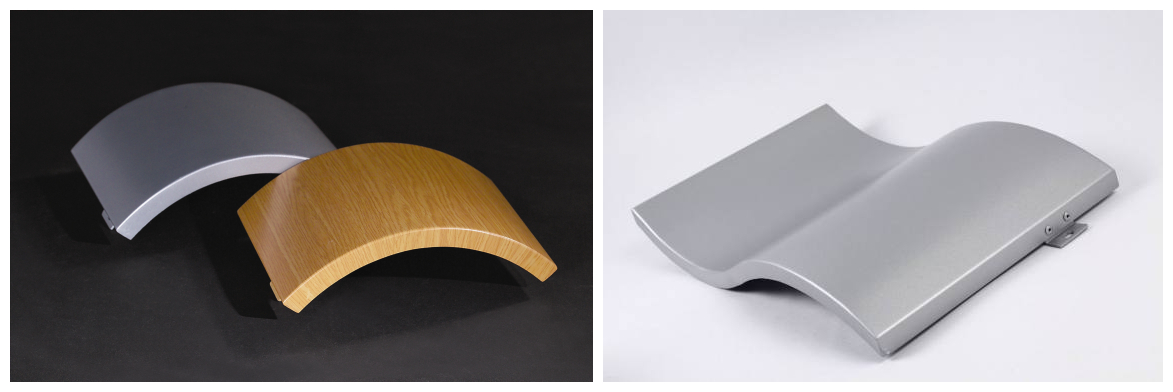
Most of the aluminum panels we commonly see have flat surfaces. In fact, aluminum panels come in a wide variety of shapes—some are single-curved, while others are double-curved. Perhaps many people don’t have a clear understanding of the differences between single-curved and double-curved aluminum panels. As a result, quite a few individuals tend to lump both types together under the umbrella term “curved aluminum panels,” without fully grasping their distinctions. Let’s take a moment to learn more about these concepts from Deprong’s editor:
In fact, the corrugated aluminum panels we commonly see are actually single-curved aluminum panels. But what about double-curved aluminum panels? A double-curved aluminum panel refers to two distinct arcs overlapping on the same panel—meaning that the arcs are drawn from two different centers of curvature, each with its own radius. Whether it’s a single-curved or a double-curved aluminum panel, the manufacturing and processing techniques involved are highly complex. The entire processing procedure places significant demands on both the hardware and software capabilities of the manufacturer. Typically, small-scale processors are simply unable to produce curved aluminum panels; only large-scale manufacturers possess the necessary expertise and equipment. Many people assume that curved aluminum panels are nothing more than aluminum panels with a certain degree of curvature. However, this isn’t the case at all. Curved aluminum panels can be further subdivided into single-curved aluminum panels, double-curved aluminum panels, spherical aluminum panels, and more. The complexity of their production process increases progressively. First, the overall curvature must be precisely calculated; then, laser seamless welding, polishing, and grinding are employed to create a curved surface or even a spherical shape. The entire processing procedure, along with subsequent surface painting, is extremely time-consuming and labor-intensive, naturally resulting in a relatively high cost.
Next, let’s take a closer look at the characteristics and application ranges of single-curved aluminum panels and double-curved aluminum panels: Single-curved aluminum panels are lightweight, highly rigid, and capable of creating multi-layered spaces. Moreover, they can be designed in a wide variety of colors and applied to more diverse architectural projects.
Single-curved aluminum panels are primarily used in outdoor applications such as column cladding, curved or spherical building facades. Double-curved aluminum panels, on the other hand, offer excellent visual presentation and allow for the creation of uniquely designed buildings. They can be custom-designed and fabricated to meet a wide range of customer requirements, fully satisfying the personalized construction needs of contractors. Double-curved aluminum panels feature an internally structured waterproof system and undergo thorough sealing treatment, thereby maximizing their outstanding water resistance. Additionally, the surface of double-curved aluminum panels can be coated with various colors of paint to further enhance their visual impact.
Key points of the summary: The fabrication of hyperbolic aluminum panels is relatively challenging, placing high demands on machine precision and requiring skilled technicians to operate with great care. As a result, hyperbolic aluminum panels have a high technological content. Compared to conventional aluminum panels, both single-curved and hyperbolic aluminum panels feature light weight, excellent rigidity, high strength, fire and moisture resistance, convenient and simple installation and maintenance, and a long service life. Precisely because of their unique curved shapes, these panels are ideally suited for curved building surfaces where conventional aluminum panels would be ineffective. Since the lines of exterior wall decorations often transition from straight walls into various curved designs, hyperbolic aluminum panels highlight a flexible and versatile artistic flair.

 鄂公网安备42062502000047